SmartEPD-2026-148-0971-01Date of IssueJun 29, 2026Expiration DateJun 29, 2031Last UpdatedJun 29, 2026Refer to the EPD Library at www.smartepd.com for the latest EPD listing informationCarboquick® 200Environmental ProductDeclarationProgram Operator: Smart EPD®www.smartepd.comIN ACCORDANCE WITH ISO 14025 AND ISO 21930:2007
General InformationCarboline2150 Schuetz Road - St. Louis, MO 631461-314-644-1000info@carboline.comcarboline.comProduct Name:Carboquick® 200Functional Unit:1 m2 of covered and protected substrate for a period of 60 yearsDeclaration Number:SmartEPD-2026-148-0971-01Date of Issue:June 29, 2026Expiration:June 29, 2031Last updated:June 29, 2026EPD Scope:Cradle to graveA1 - A3, A4, A5, B1 - B7, C1 - C4Market(s) of Applicability:North AmericaGeneral Organization InformationCarboline is a global leader in high-performance protective coatings, linings, and fireproofing, specializing in the preservation of critical infrastructure throughadvanced corrosion and fire protection technologies. Founded in 1947 and now a subsidiary of RPM International Inc., the company operates an extensiveglobal network with over 20 manufacturing facilities serving industries such as oil and gas, power generation, and commercial construction. They are widelyrecognized for iconic product lines like Carbozinc, Carboguard, and Southwest fireproofing, as well as their rigorous UL-certified testing and commitment tolow-VOC, sustainable solutions. By combining deep technical expertise with a focus on research and development, Carboline provides engineered systemsthat extend the service life of assets in some of the world's most aggressive environments.Further information can be found at:https://www.carboline.com/Limitations, Liability and OwnershipEnvironmental declarations from different programs (ISO 14025) may not be comparable. Comparison of the environmental performance of products usingEPD information shall be based on the product’s use and impacts at the building level, and therefore EPDs may not be used for comparability purposes whennot considering the whole building life cycle. EPD comparability is only possible when all stages of a life cycle have been considered. However, variations anddeviations are possible. Example of variations: Different LCA software and background LCI datasets may lead to differences results for upstream ordownstream of the life cycle stages declared. The EPD owner has sole ownership, liability, and responsibility for the EPD.Reference StandardsStandard(s):ISO 14025 and ISO 21930:2007Core PCR:NSF PCR for Architectural Coatings v.1Date of issue: June 18, 2015Carboquick® 200CarbolinePage 2 / 19
Valid until: June 30, 2026Sub-category PCR review panel:Contact Smart EPD for more information.General Program Instructions:Smart EPD General Program Instructions v.2.0, March 2025Verification InformationLCA Author/Creator:Harshil Desaiharshil@parqhq.comEPD Program Operator:Smart EPDinfo@smartepd.comwww.smartepd.com585 Grove St., Ste. 145, Herndon, VA 20170, USAVerification:Independent critical review of the LCA and data, according to ISO 14044 andISO 14071:ExternalAmy LandisMichigan Technological Universitylandis@mtu.eduIndependent external verification of EPD, according to ISO 14025 andreference PCR(s):ExternalAmy LandisMichigan Technological Universitylandis@mtu.eduProduct InformationFunctional Unit:1 m2 of covered and protected substrate for a period of 60 yearsMass:0.391 kgReference Service Life:5 YearsProduct Specificity:Product AverageProduct SpecificRepresentative Product EPDProduct DescriptionCarboquick® 200 is a high-performance Aliphatic Polyaspartic coating engineered as a rapid-curing, "one-coat" solution for industrial corrosion protection.Its primary advantage is the ability to be applied Direct to Metal (DTM) at a substantial thickness of 6 to 10 mils DFT, effectively eliminating the need fortraditional primer and intermediate layers to save significant labor and time. The product is characterized by extreme durability, offering excellentweatherability, impact resistance, and flexibility, while meeting rigorous ISO 12944-6 C3 High standards. Furthermore, it is a low-VOC, user-friendly systemthat remains recoatable indefinitely, making it ideal for fast-paced projects in both general industrial settings and USDA-inspected facilities.Further information can be found at:https://www.carboline.com/products/product-details/Carboquick-200/Product SpecificationsProduct SKU(s):Carboquick® 200Carboquick® 200CarbolinePage 3 / 19
Product Classification Codes:EC3 - Finishes -> PaintingAndCoatingArchitectural Coating Subcategory:Indoor and Outdoor Architectural CoatingMarket-Based Lifetime:5 yearsMaterial CompositionMaterial/Component CategoryOrigin% MassAdditive< 10Filler11 - 17Pigment18 - 28Resin39 - 59Solvent< 10Packaging MaterialOriginkg MassSteel generic0.04Hazardous MaterialsASPARTIC ESTER (136210-32-7)TITANIUM DIOXIDE (13463-67-7)CARBON BLACK (1333-86-4)ALIPHATIC CARBOXYLIC ESTER (623-91-6)ETHYL BENZENE (100-41-4)HOMOPOLYMER OF HDI (28182-81-2)METHYL ETHYL KETONE (78-93-3)N-BUTYL ACETATE (123-86-4)AROMATIC HYDROCARBON (64742-95-6)HEXAMETHYLENE DIISOCYANATE (822-06-0)EPD Data SpecificityPrimary Data Year:Jan 1, 2025 - Dec 31, 2025Manufacturing Specificity:Industry AverageManufacturer AverageFacility SpecificAveraging:Carboquick® 200CarbolinePage 4 / 19
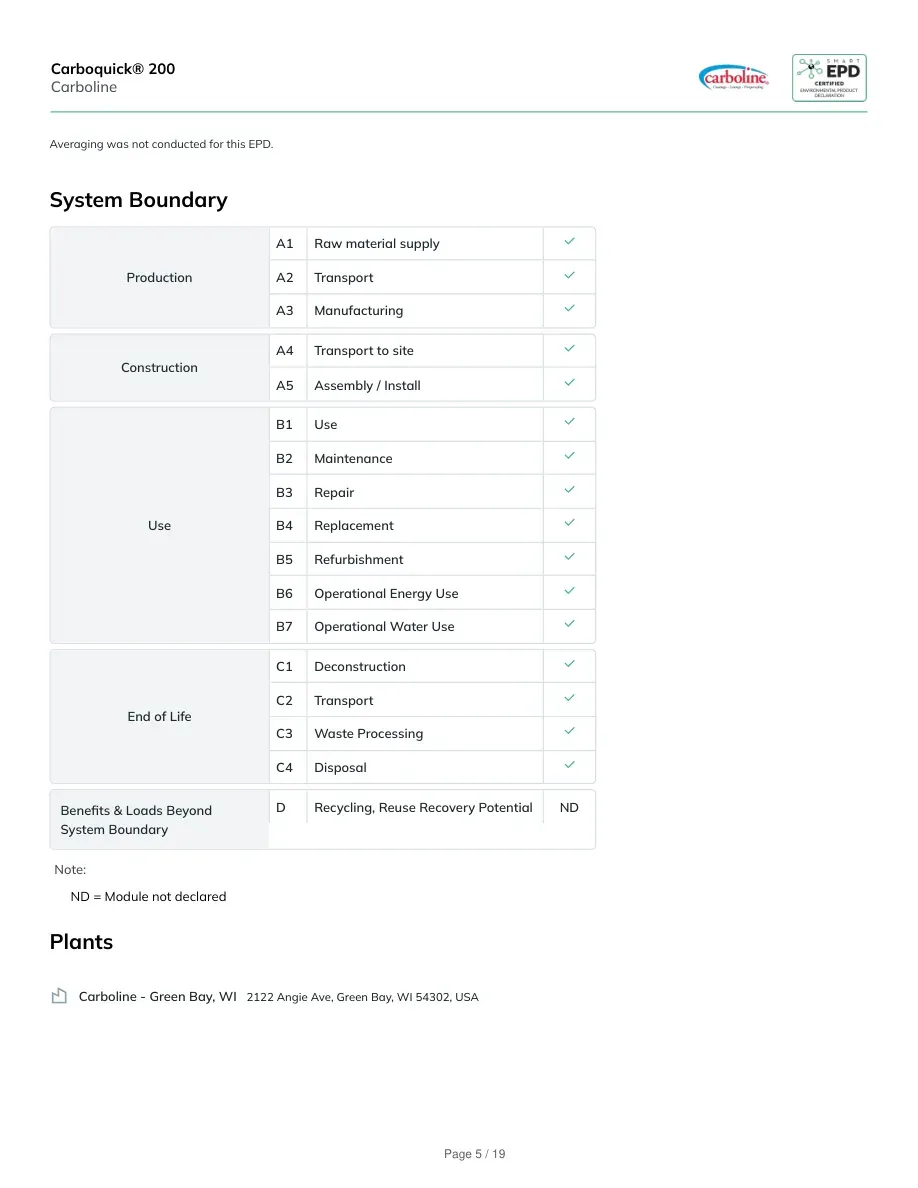
Averaging was not conducted for this EPD.System BoundaryProductionA1Raw material supplyA2TransportA3ManufacturingConstructionA4Transport to siteA5Assembly / InstallUseB1UseB2MaintenanceB3RepairB4ReplacementB5RefurbishmentB6Operational Energy UseB7Operational Water UseEnd of LifeC1DeconstructionC2TransportC3Waste ProcessingC4DisposalBenefits & Loads BeyondSystem BoundaryDRecycling, Reuse Recovery PotentialNDNote:ND = Module not declaredPlantsCarboline - Green Bay, WI2122 Angie Ave, Green Bay, WI 54302, USACarboquick® 200CarbolinePage 5 / 19
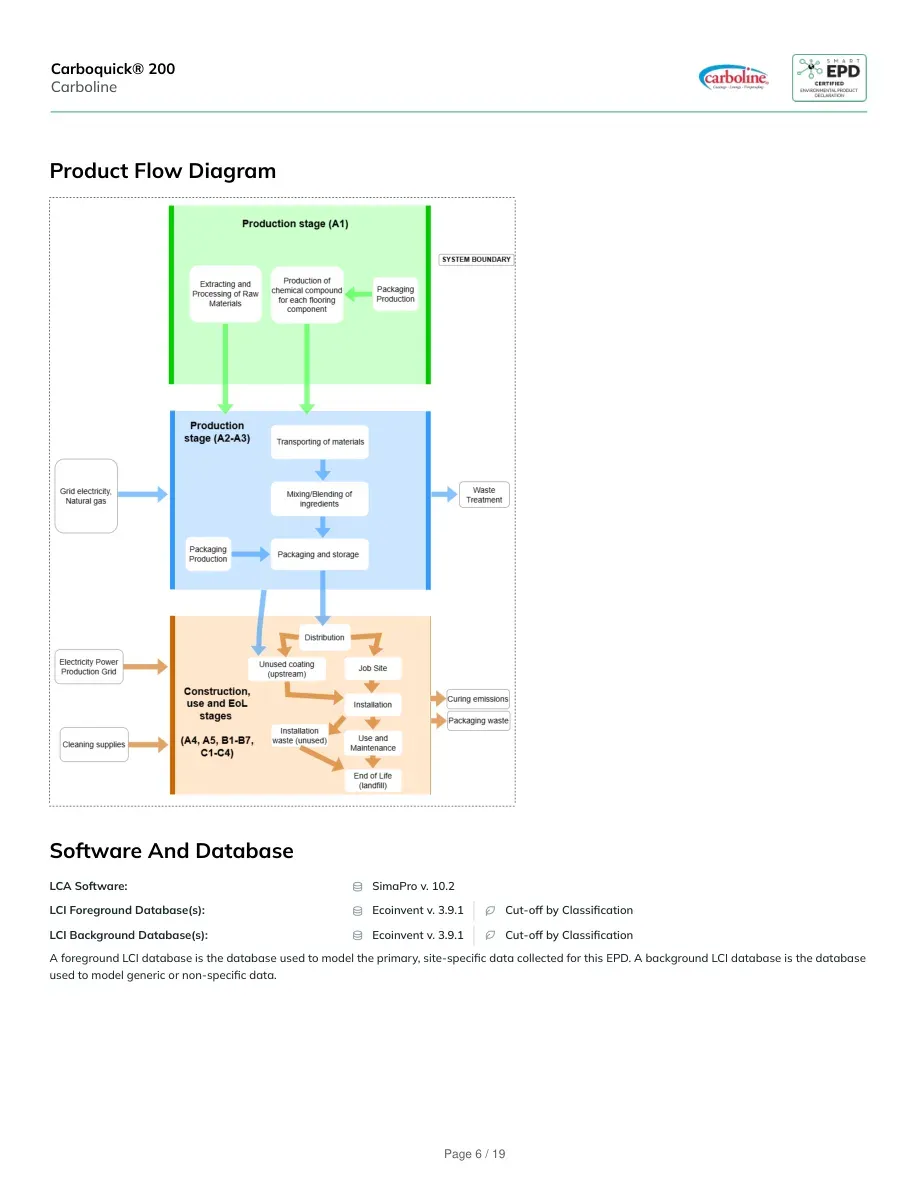
Product Flow DiagramSoftware And DatabaseLCA Software:SimaPro v. 10.2LCI Foreground Database(s):Ecoinvent v. 3.9.1Cut-off by ClassificationLCI Background Database(s):Ecoinvent v. 3.9.1Cut-off by ClassificationA foreground LCI database is the database used to model the primary, site-specific data collected for this EPD. A background LCI database is the databaseused to model generic or non-specific data.Carboquick® 200CarbolinePage 6 / 19
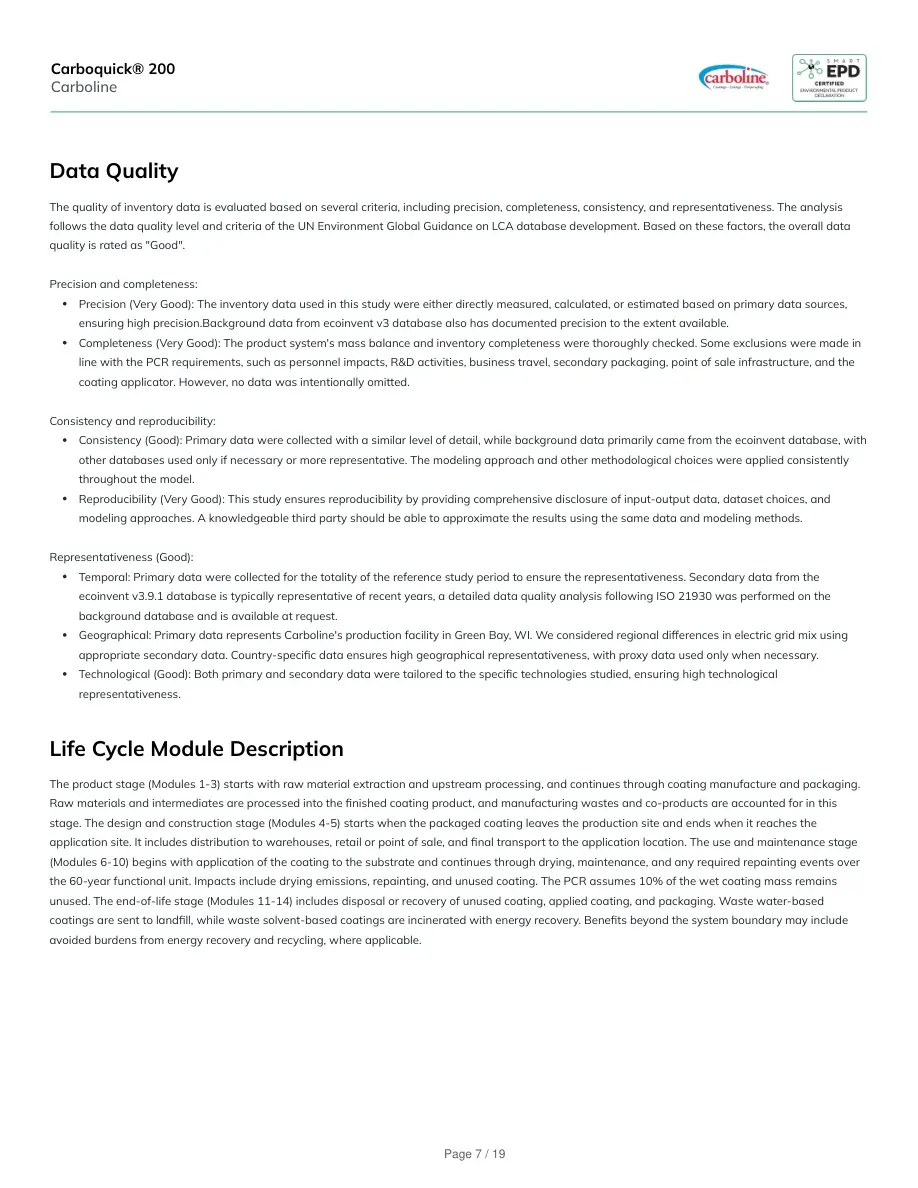
Data QualityThe quality of inventory data is evaluated based on several criteria, including precision, completeness, consistency, and representativeness. The analysisfollows the data quality level and criteria of the UN Environment Global Guidance on LCA database development. Based on these factors, the overall dataquality is rated as "Good".Precision and completeness:Precision (Very Good): The inventory data used in this study were either directly measured, calculated, or estimated based on primary data sources,ensuring high precision.Background data from ecoinvent v3 database also has documented precision to the extent available.Completeness (Very Good): The product system's mass balance and inventory completeness were thoroughly checked. Some exclusions were made inline with the PCR requirements, such as personnel impacts, R&D activities, business travel, secondary packaging, point of sale infrastructure, and thecoating applicator. However, no data was intentionally omitted.Consistency and reproducibility:Consistency (Good): Primary data were collected with a similar level of detail, while background data primarily came from the ecoinvent database, withother databases used only if necessary or more representative. The modeling approach and other methodological choices were applied consistentlythroughout the model.Reproducibility (Very Good): This study ensures reproducibility by providing comprehensive disclosure of input-output data, dataset choices, andmodeling approaches. A knowledgeable third party should be able to approximate the results using the same data and modeling methods.Representativeness (Good):Temporal: Primary data were collected for the totality of the reference study period to ensure the representativeness. Secondary data from theecoinvent v3.9.1 database is typically representative of recent years, a detailed data quality analysis following ISO 21930 was performed on thebackground database and is available at request.Geographical: Primary data represents Carboline's production facility in Green Bay, WI. We considered regional differences in electric grid mix usingappropriate secondary data. Country-specific data ensures high geographical representativeness, with proxy data used only when necessary.Technological (Good): Both primary and secondary data were tailored to the specific technologies studied, ensuring high technologicalrepresentativeness.Life Cycle Module DescriptionThe product stage (Modules 1-3) starts with raw material extraction and upstream processing, and continues through coating manufacture and packaging.Raw materials and intermediates are processed into the finished coating product, and manufacturing wastes and co-products are accounted for in thisstage. The design and construction stage (Modules 4-5) starts when the packaged coating leaves the production site and ends when it reaches theapplication site. It includes distribution to warehouses, retail or point of sale, and final transport to the application location. The use and maintenance stage(Modules 6-10) begins with application of the coating to the substrate and continues through drying, maintenance, and any required repainting events overthe 60-year functional unit. Impacts include drying emissions, repainting, and unused coating. The PCR assumes 10% of the wet coating mass remainsunused. The end-of-life stage (Modules 11-14) includes disposal or recovery of unused coating, applied coating, and packaging. Waste water-basedcoatings are sent to landfill, while waste solvent-based coatings are incinerated with energy recovery. Benefits beyond the system boundary may includeavoided burdens from energy recovery and recycling, where applicable.Carboquick® 200CarbolinePage 7 / 19
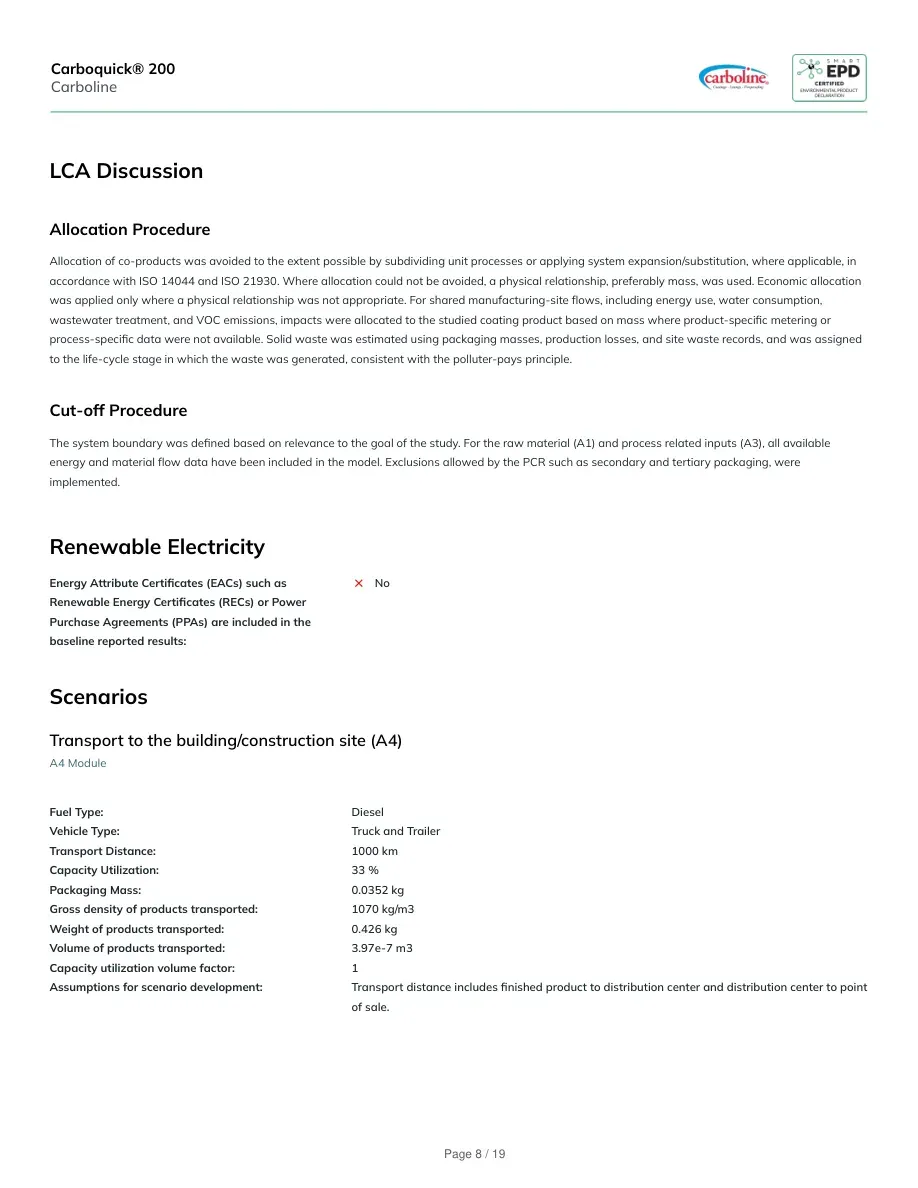
LCA DiscussionAllocation ProcedureAllocation of co-products was avoided to the extent possible by subdividing unit processes or applying system expansion/substitution, where applicable, inaccordance with ISO 14044 and ISO 21930. Where allocation could not be avoided, a physical relationship, preferably mass, was used. Economic allocationwas applied only where a physical relationship was not appropriate. For shared manufacturing-site flows, including energy use, water consumption,wastewater treatment, and VOC emissions, impacts were allocated to the studied coating product based on mass where product-specific metering orprocess-specific data were not available. Solid waste was estimated using packaging masses, production losses, and site waste records, and was assignedto the life-cycle stage in which the waste was generated, consistent with the polluter-pays principle.Cut-off ProcedureThe system boundary was defined based on relevance to the goal of the study. For the raw material (A1) and process related inputs (A3), all availableenergy and material flow data have been included in the model. Exclusions allowed by the PCR such as secondary and tertiary packaging, wereimplemented.Renewable ElectricityEnergy Attribute Certificates (EACs) such asRenewable Energy Certificates (RECs) or PowerPurchase Agreements (PPAs) are included in thebaseline reported results:NoScenariosTransport to the building/construction site (A4)A4 ModuleFuel Type:DieselVehicle Type:Truck and TrailerTransport Distance:1000 kmCapacity Utilization:33 %Packaging Mass:0.0352 kgGross density of products transported:1070 kg/m3Weight of products transported:0.426 kgVolume of products transported:3.97e-7 m3Capacity utilization volume factor:1Assumptions for scenario development:Transport distance includes finished product to distribution center and distribution center to pointof sale.Carboquick® 200CarbolinePage 8 / 19
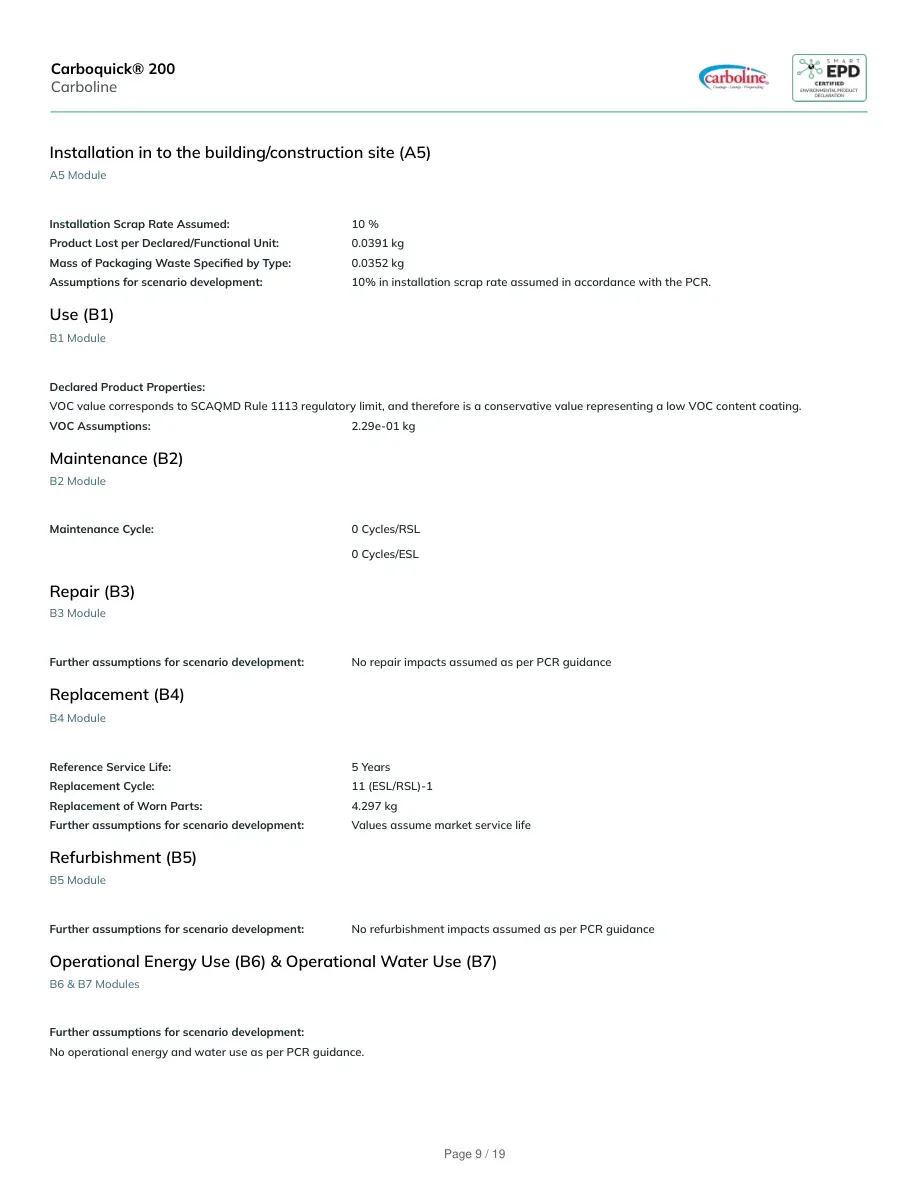
Installation in to the building/construction site (A5)A5 ModuleInstallation Scrap Rate Assumed:10 %Product Lost per Declared/Functional Unit:0.0391 kgMass of Packaging Waste Specified by Type:0.0352 kgAssumptions for scenario development:10% in installation scrap rate assumed in accordance with the PCR.Use (B1)B1 ModuleDeclared Product Properties:VOC value corresponds to SCAQMD Rule 1113 regulatory limit, and therefore is a conservative value representing a low VOC content coating.VOC Assumptions:2.29e-01 kgMaintenance (B2)B2 ModuleMaintenance Cycle:0 Cycles/RSL0 Cycles/ESLRepair (B3)B3 ModuleFurther assumptions for scenario development:No repair impacts assumed as per PCR guidanceReplacement (B4)B4 ModuleReference Service Life:5 YearsReplacement Cycle:11 (ESL/RSL)-1Replacement of Worn Parts:4.297 kgFurther assumptions for scenario development:Values assume market service lifeRefurbishment (B5)B5 ModuleFurther assumptions for scenario development:No refurbishment impacts assumed as per PCR guidanceOperational Energy Use (B6) & Operational Water Use (B7)B6 & B7 ModulesFurther assumptions for scenario development:No operational energy and water use as per PCR guidance.Carboquick® 200CarbolinePage 9 / 19
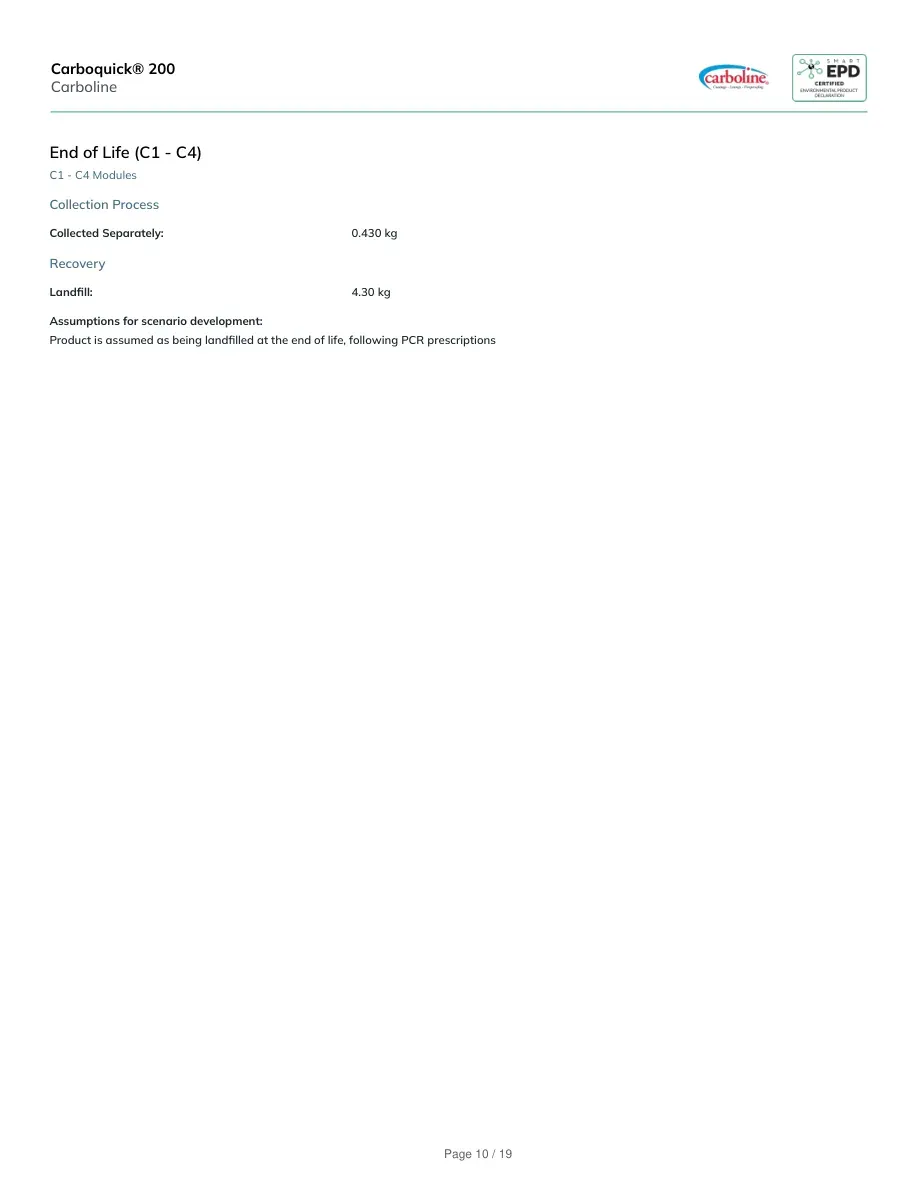
End of Life (C1 - C4)C1 - C4 ModulesCollection ProcessCollected Separately:0.430 kgRecoveryLandfill:4.30 kgAssumptions for scenario development:Product is assumed as being landfilled at the end of life, following PCR prescriptionsCarboquick® 200CarbolinePage 10 / 19
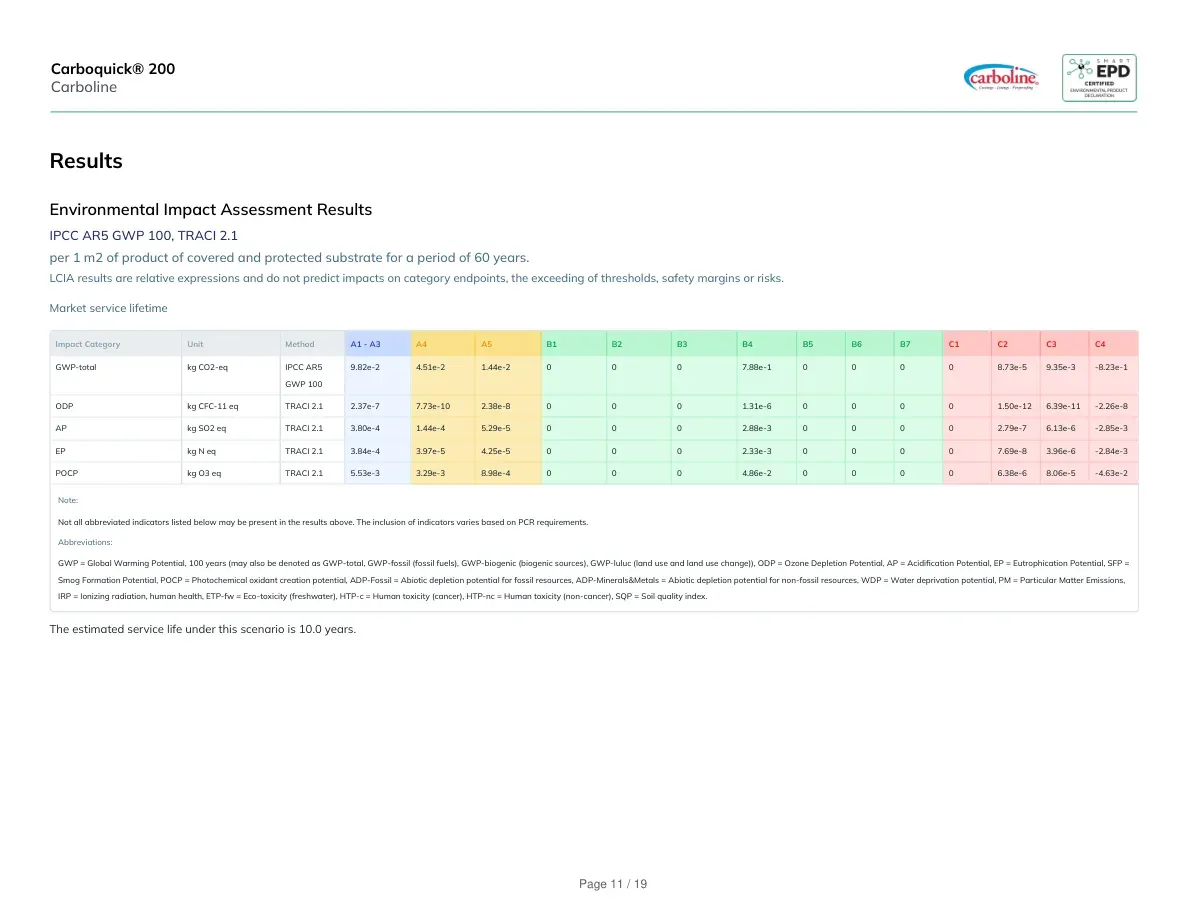
ResultsEnvironmental Impact Assessment ResultsIPCC AR5 GWP 100, TRACI 2.1per 1 m2 of product of covered and protected substrate for a period of 60 years.LCIA results are relative expressions and do not predict impacts on category endpoints, the exceeding of thresholds, safety margins or risks.Market service lifetimeImpact CategoryUnitMethodA1 - A3A4A5B1B2B3B4B5B6B7C1C2C3C4GWP-totalkg CO2-eqIPCC AR5GWP 1009.82e-24.51e-21.44e-20007.88e-100008.73e-59.35e-3-8.23e-1ODPkg CFC-11 eqTRACI 2.12.37e-77.73e-102.38e-80001.31e-600001.50e-126.39e-11-2.26e-8APkg SO2 eqTRACI 2.13.80e-41.44e-45.29e-50002.88e-300002.79e-76.13e-6-2.85e-3EPkg N eqTRACI 2.13.84e-43.97e-54.25e-50002.33e-300007.69e-83.96e-6-2.84e-3POCPkg O3 eqTRACI 2.15.53e-33.29e-38.98e-40004.86e-200006.38e-68.06e-5-4.63e-2Note:Not all abbreviated indicators listed below may be present in the results above. The inclusion of indicators varies based on PCR requirements.Abbreviations:GWP = Global Warming Potential, 100 years (may also be denoted as GWP-total, GWP-fossil (fossil fuels), GWP-biogenic (biogenic sources), GWP-luluc (land use and land use change)), ODP = Ozone Depletion Potential, AP = Acidification Potential, EP = Eutrophication Potential, SFP =Smog Formation Potential, POCP = Photochemical oxidant creation potential, ADP-Fossil = Abiotic depletion potential for fossil resources, ADP-Minerals&Metals = Abiotic depletion potential for non-fossil resources, WDP = Water deprivation potential, PM = Particular Matter Emissions,IRP = Ionizing radiation, human health, ETP-fw = Eco-toxicity (freshwater), HTP-c = Human toxicity (cancer), HTP-nc = Human toxicity (non-cancer), SQP = Soil quality index.The estimated service life under this scenario is 10.0 years.Carboquick® 200CarbolinePage 11 / 19
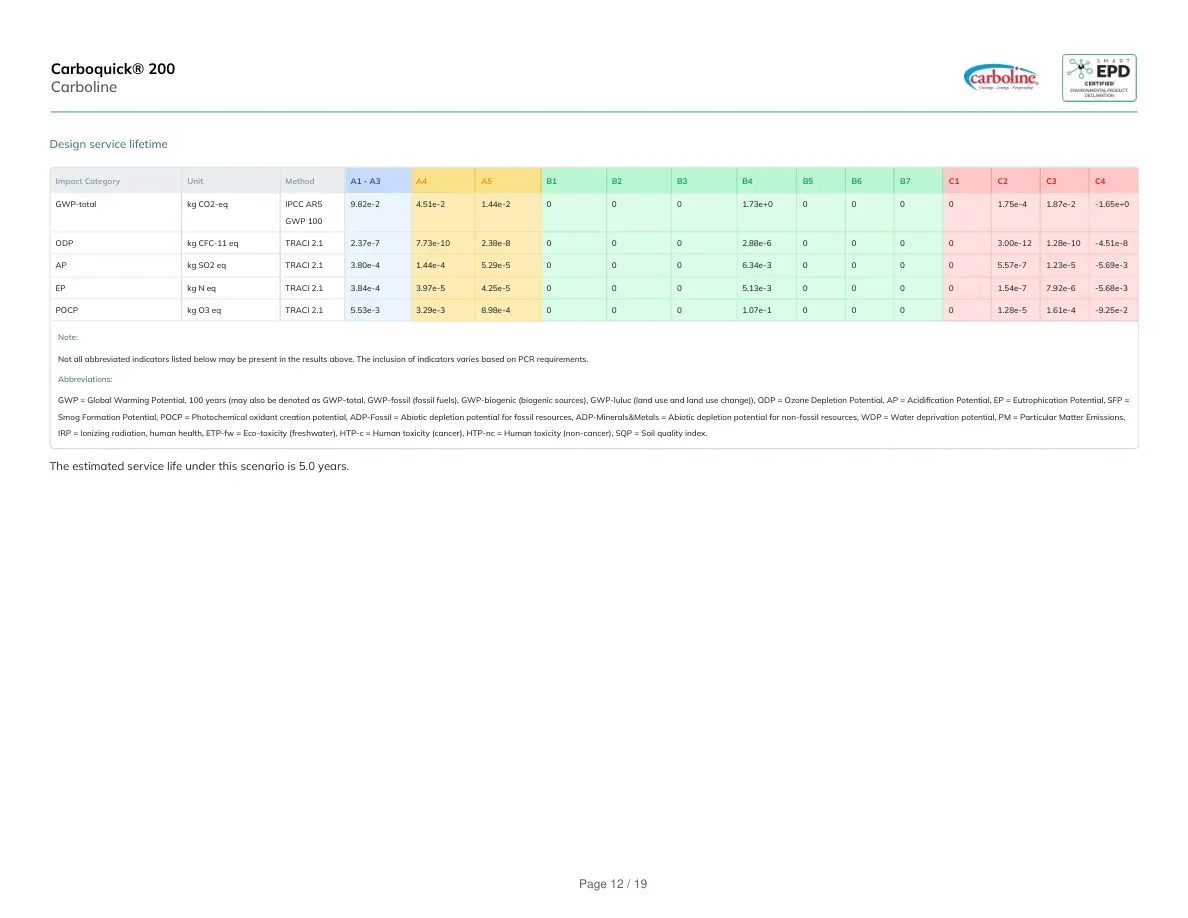
Design service lifetimeImpact CategoryUnitMethodA1 - A3A4A5B1B2B3B4B5B6B7C1C2C3C4GWP-totalkg CO2-eqIPCC AR5GWP 1009.82e-24.51e-21.44e-20001.73e+000001.75e-41.87e-2-1.65e+0ODPkg CFC-11 eqTRACI 2.12.37e-77.73e-102.38e-80002.88e-600003.00e-121.28e-10-4.51e-8APkg SO2 eqTRACI 2.13.80e-41.44e-45.29e-50006.34e-300005.57e-71.23e-5-5.69e-3EPkg N eqTRACI 2.13.84e-43.97e-54.25e-50005.13e-300001.54e-77.92e-6-5.68e-3POCPkg O3 eqTRACI 2.15.53e-33.29e-38.98e-40001.07e-100001.28e-51.61e-4-9.25e-2Note:Not all abbreviated indicators listed below may be present in the results above. The inclusion of indicators varies based on PCR requirements.Abbreviations:GWP = Global Warming Potential, 100 years (may also be denoted as GWP-total, GWP-fossil (fossil fuels), GWP-biogenic (biogenic sources), GWP-luluc (land use and land use change)), ODP = Ozone Depletion Potential, AP = Acidification Potential, EP = Eutrophication Potential, SFP =Smog Formation Potential, POCP = Photochemical oxidant creation potential, ADP-Fossil = Abiotic depletion potential for fossil resources, ADP-Minerals&Metals = Abiotic depletion potential for non-fossil resources, WDP = Water deprivation potential, PM = Particular Matter Emissions,IRP = Ionizing radiation, human health, ETP-fw = Eco-toxicity (freshwater), HTP-c = Human toxicity (cancer), HTP-nc = Human toxicity (non-cancer), SQP = Soil quality index.The estimated service life under this scenario is 5.0 years.Carboquick® 200CarbolinePage 12 / 19
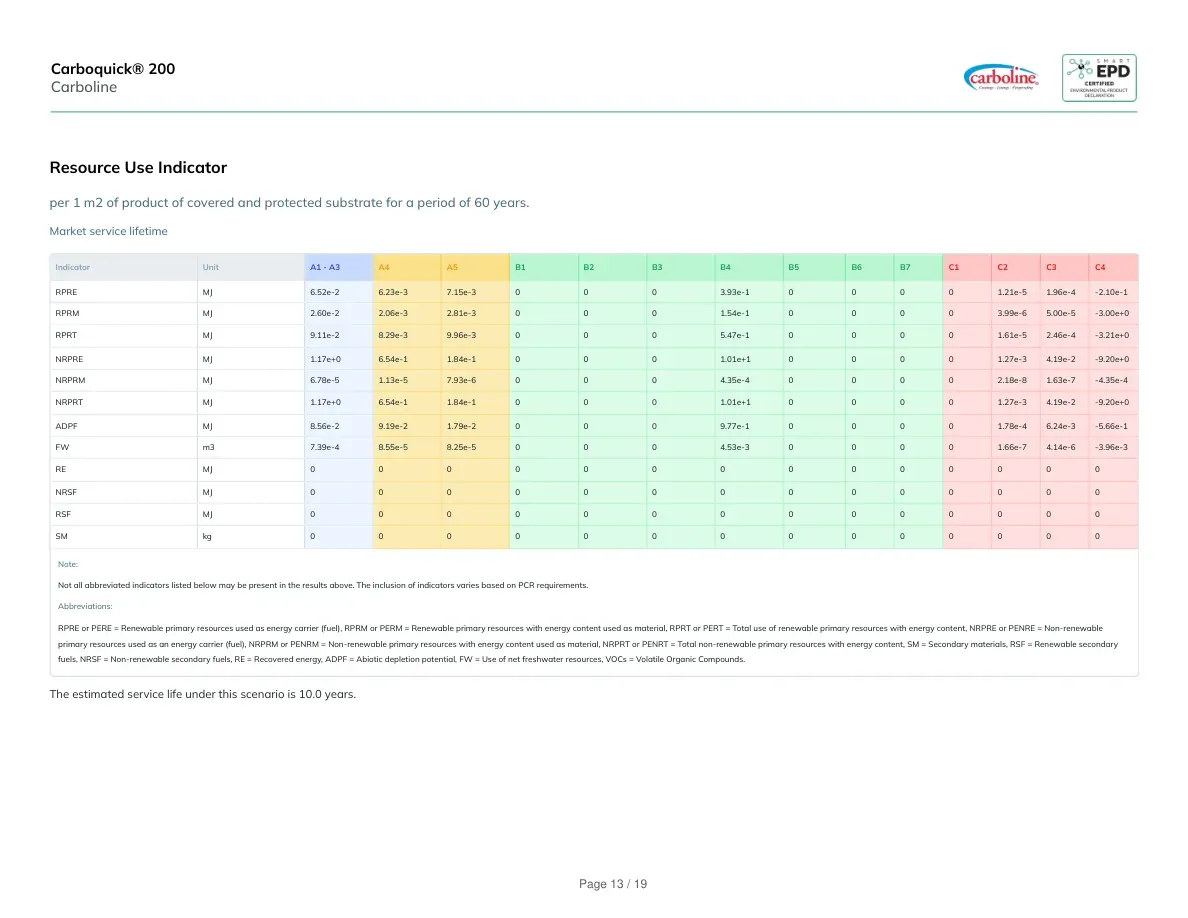
Resource Use Indicatorper 1 m2 of product of covered and protected substrate for a period of 60 years.Market service lifetimeIndicatorUnitA1 - A3A4A5B1B2B3B4B5B6B7C1C2C3C4RPREMJ6.52e-26.23e-37.15e-30003.93e-100001.21e-51.96e-4-2.10e-1RPRMMJ2.60e-22.06e-32.81e-30001.54e-100003.99e-65.00e-5-3.00e+0RPRTMJ9.11e-28.29e-39.96e-30005.47e-100001.61e-52.46e-4-3.21e+0NRPREMJ1.17e+06.54e-11.84e-10001.01e+100001.27e-34.19e-2-9.20e+0NRPRMMJ6.78e-51.13e-57.93e-60004.35e-400002.18e-81.63e-7-4.35e-4NRPRTMJ1.17e+06.54e-11.84e-10001.01e+100001.27e-34.19e-2-9.20e+0ADPFMJ8.56e-29.19e-21.79e-20009.77e-100001.78e-46.24e-3-5.66e-1FWm37.39e-48.55e-58.25e-50004.53e-300001.66e-74.14e-6-3.96e-3REMJ00000000000000NRSFMJ00000000000000RSFMJ00000000000000SMkg00000000000000Note:Not all abbreviated indicators listed below may be present in the results above. The inclusion of indicators varies based on PCR requirements.Abbreviations:RPRE or PERE = Renewable primary resources used as energy carrier (fuel), RPRM or PERM = Renewable primary resources with energy content used as material, RPRT or PERT = Total use of renewable primary resources with energy content, NRPRE or PENRE = Non-renewableprimary resources used as an energy carrier (fuel), NRPRM or PENRM = Non-renewable primary resources with energy content used as material, NRPRT or PENRT = Total non-renewable primary resources with energy content, SM = Secondary materials, RSF = Renewable secondaryfuels, NRSF = Non-renewable secondary fuels, RE = Recovered energy, ADPF = Abiotic depletion potential, FW = Use of net freshwater resources, VOCs = Volatile Organic Compounds.The estimated service life under this scenario is 10.0 years.Carboquick® 200CarbolinePage 13 / 19
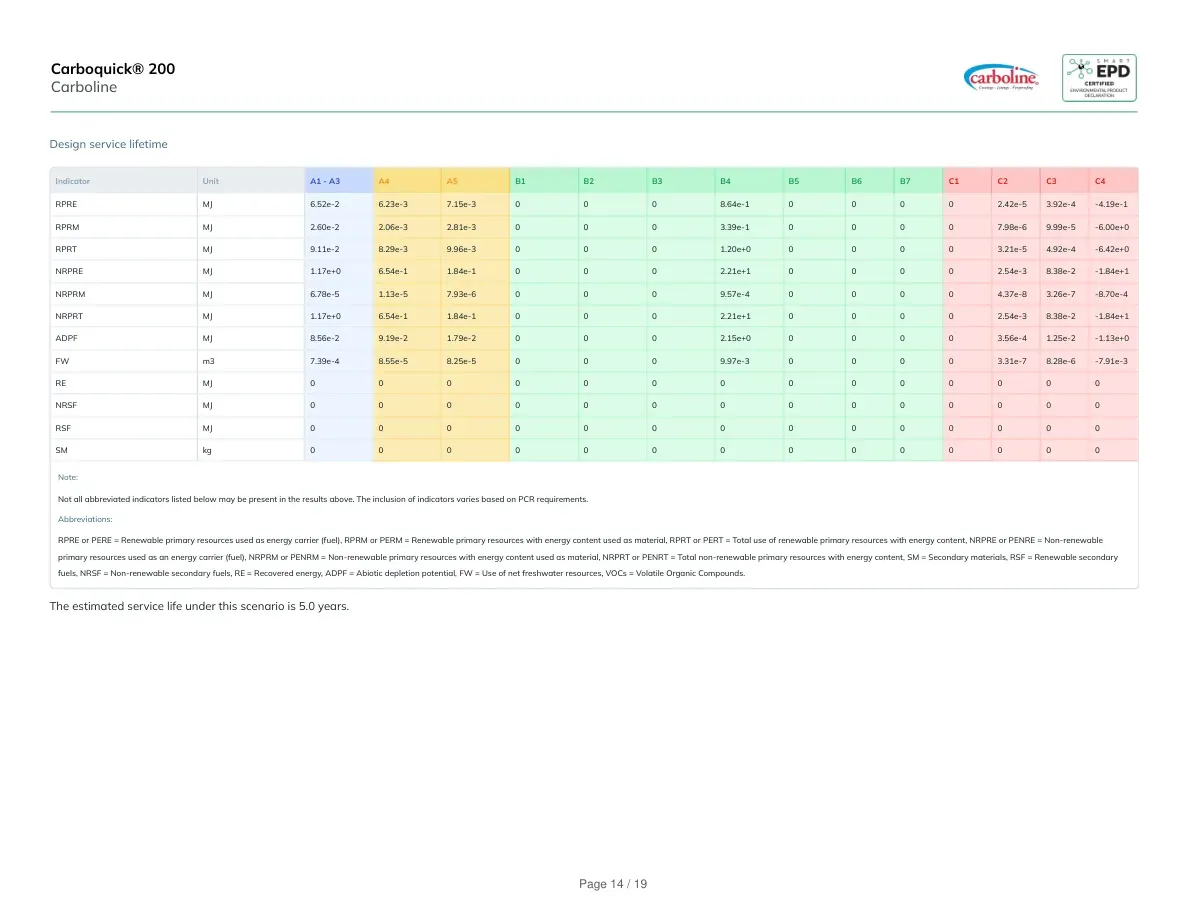
Design service lifetimeIndicatorUnitA1 - A3A4A5B1B2B3B4B5B6B7C1C2C3C4RPREMJ6.52e-26.23e-37.15e-30008.64e-100002.42e-53.92e-4-4.19e-1RPRMMJ2.60e-22.06e-32.81e-30003.39e-100007.98e-69.99e-5-6.00e+0RPRTMJ9.11e-28.29e-39.96e-30001.20e+000003.21e-54.92e-4-6.42e+0NRPREMJ1.17e+06.54e-11.84e-10002.21e+100002.54e-38.38e-2-1.84e+1NRPRMMJ6.78e-51.13e-57.93e-60009.57e-400004.37e-83.26e-7-8.70e-4NRPRTMJ1.17e+06.54e-11.84e-10002.21e+100002.54e-38.38e-2-1.84e+1ADPFMJ8.56e-29.19e-21.79e-20002.15e+000003.56e-41.25e-2-1.13e+0FWm37.39e-48.55e-58.25e-50009.97e-300003.31e-78.28e-6-7.91e-3REMJ00000000000000NRSFMJ00000000000000RSFMJ00000000000000SMkg00000000000000Note:Not all abbreviated indicators listed below may be present in the results above. The inclusion of indicators varies based on PCR requirements.Abbreviations:RPRE or PERE = Renewable primary resources used as energy carrier (fuel), RPRM or PERM = Renewable primary resources with energy content used as material, RPRT or PERT = Total use of renewable primary resources with energy content, NRPRE or PENRE = Non-renewableprimary resources used as an energy carrier (fuel), NRPRM or PENRM = Non-renewable primary resources with energy content used as material, NRPRT or PENRT = Total non-renewable primary resources with energy content, SM = Secondary materials, RSF = Renewable secondaryfuels, NRSF = Non-renewable secondary fuels, RE = Recovered energy, ADPF = Abiotic depletion potential, FW = Use of net freshwater resources, VOCs = Volatile Organic Compounds.The estimated service life under this scenario is 5.0 years.Carboquick® 200CarbolinePage 14 / 19
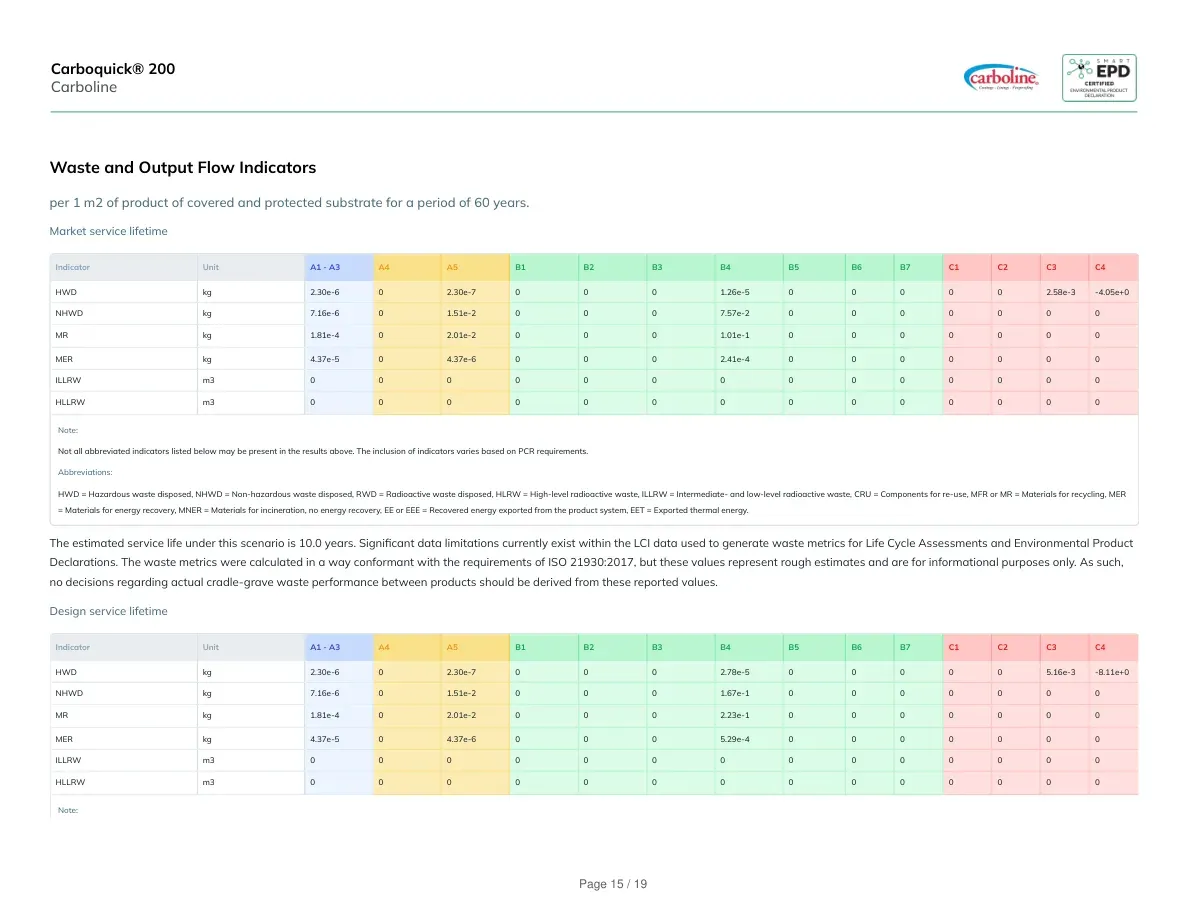
Waste and Output Flow Indicatorsper 1 m2 of product of covered and protected substrate for a period of 60 years.Market service lifetimeIndicatorUnitA1 - A3A4A5B1B2B3B4B5B6B7C1C2C3C4HWDkg2.30e-602.30e-70001.26e-5000002.58e-3-4.05e+0NHWDkg7.16e-601.51e-20007.57e-20000000MRkg1.81e-402.01e-20001.01e-10000000MERkg4.37e-504.37e-60002.41e-40000000ILLRWm300000000000000HLLRWm300000000000000Note:Not all abbreviated indicators listed below may be present in the results above. The inclusion of indicators varies based on PCR requirements.Abbreviations:HWD = Hazardous waste disposed, NHWD = Non-hazardous waste disposed, RWD = Radioactive waste disposed, HLRW = High-level radioactive waste, ILLRW = Intermediate- and low-level radioactive waste, CRU = Components for re-use, MFR or MR = Materials for recycling, MER= Materials for energy recovery, MNER = Materials for incineration, no energy recovery, EE or EEE = Recovered energy exported from the product system, EET = Exported thermal energy.The estimated service life under this scenario is 10.0 years. Significant data limitations currently exist within the LCI data used to generate waste metrics for Life Cycle Assessments and Environmental ProductDeclarations. The waste metrics were calculated in a way conformant with the requirements of ISO 21930:2017, but these values represent rough estimates and are for informational purposes only. As such,no decisions regarding actual cradle-grave waste performance between products should be derived from these reported values.Design service lifetimeIndicatorUnitA1 - A3A4A5B1B2B3B4B5B6B7C1C2C3C4HWDkg2.30e-602.30e-70002.78e-5000005.16e-3-8.11e+0NHWDkg7.16e-601.51e-20001.67e-10000000MRkg1.81e-402.01e-20002.23e-10000000MERkg4.37e-504.37e-60005.29e-40000000ILLRWm300000000000000HLLRWm300000000000000Note:Carboquick® 200CarbolinePage 15 / 19
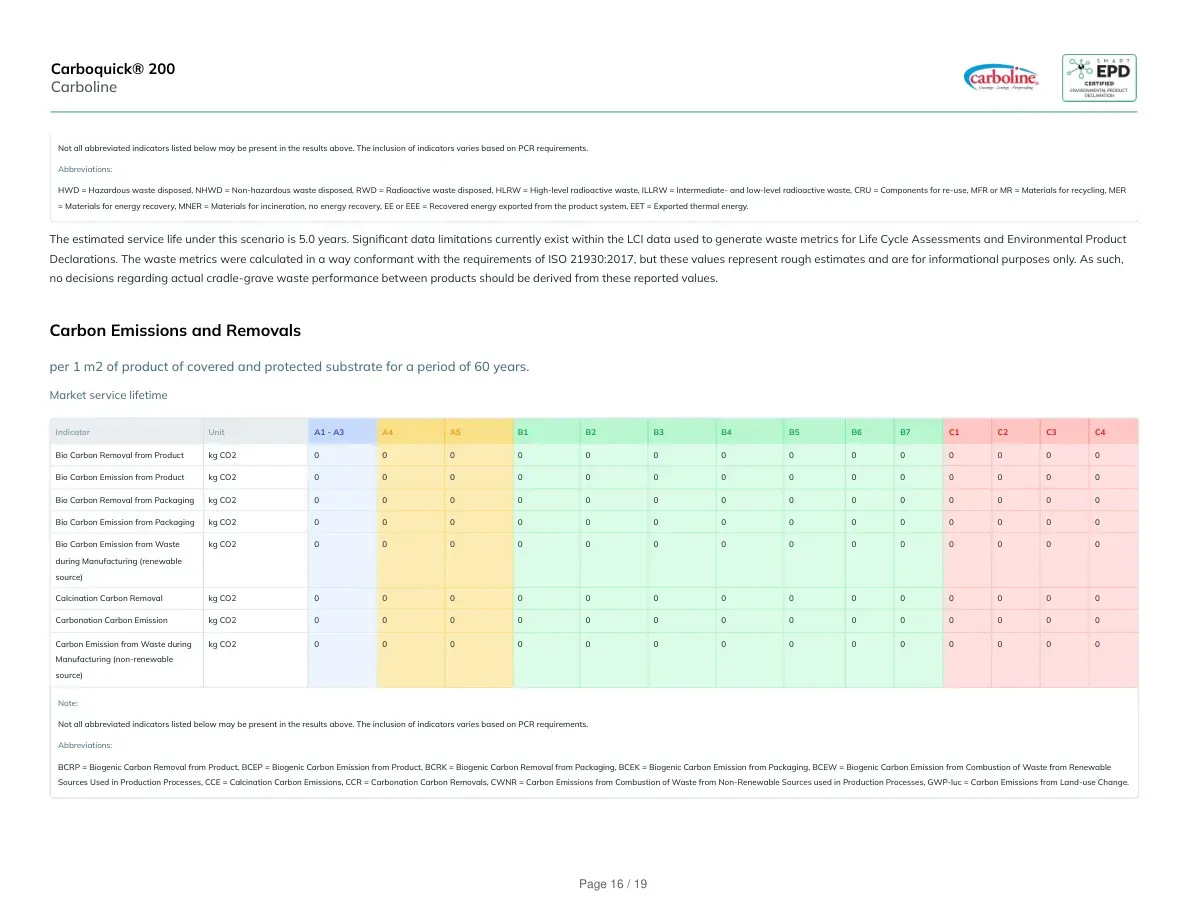
Not all abbreviated indicators listed below may be present in the results above. The inclusion of indicators varies based on PCR requirements.Abbreviations:HWD = Hazardous waste disposed, NHWD = Non-hazardous waste disposed, RWD = Radioactive waste disposed, HLRW = High-level radioactive waste, ILLRW = Intermediate- and low-level radioactive waste, CRU = Components for re-use, MFR or MR = Materials for recycling, MER= Materials for energy recovery, MNER = Materials for incineration, no energy recovery, EE or EEE = Recovered energy exported from the product system, EET = Exported thermal energy.The estimated service life under this scenario is 5.0 years. Significant data limitations currently exist within the LCI data used to generate waste metrics for Life Cycle Assessments and Environmental ProductDeclarations. The waste metrics were calculated in a way conformant with the requirements of ISO 21930:2017, but these values represent rough estimates and are for informational purposes only. As such,no decisions regarding actual cradle-grave waste performance between products should be derived from these reported values.Carbon Emissions and Removalsper 1 m2 of product of covered and protected substrate for a period of 60 years.Market service lifetimeIndicatorUnitA1 - A3A4A5B1B2B3B4B5B6B7C1C2C3C4Bio Carbon Removal from Productkg CO200000000000000Bio Carbon Emission from Productkg CO200000000000000Bio Carbon Removal from Packagingkg CO200000000000000Bio Carbon Emission from Packagingkg CO200000000000000Bio Carbon Emission from Wasteduring Manufacturing (renewablesource)kg CO200000000000000Calcination Carbon Removalkg CO200000000000000Carbonation Carbon Emissionkg CO200000000000000Carbon Emission from Waste duringManufacturing (non-renewablesource)kg CO200000000000000Note:Not all abbreviated indicators listed below may be present in the results above. The inclusion of indicators varies based on PCR requirements.Abbreviations:BCRP = Biogenic Carbon Removal from Product, BCEP = Biogenic Carbon Emission from Product, BCRK = Biogenic Carbon Removal from Packaging, BCEK = Biogenic Carbon Emission from Packaging, BCEW = Biogenic Carbon Emission from Combustion of Waste from RenewableSources Used in Production Processes, CCE = Calcination Carbon Emissions, CCR = Carbonation Carbon Removals, CWNR = Carbon Emissions from Combustion of Waste from Non-Renewable Sources used in Production Processes, GWP-luc = Carbon Emissions from Land-use Change.Carboquick® 200CarbolinePage 16 / 19
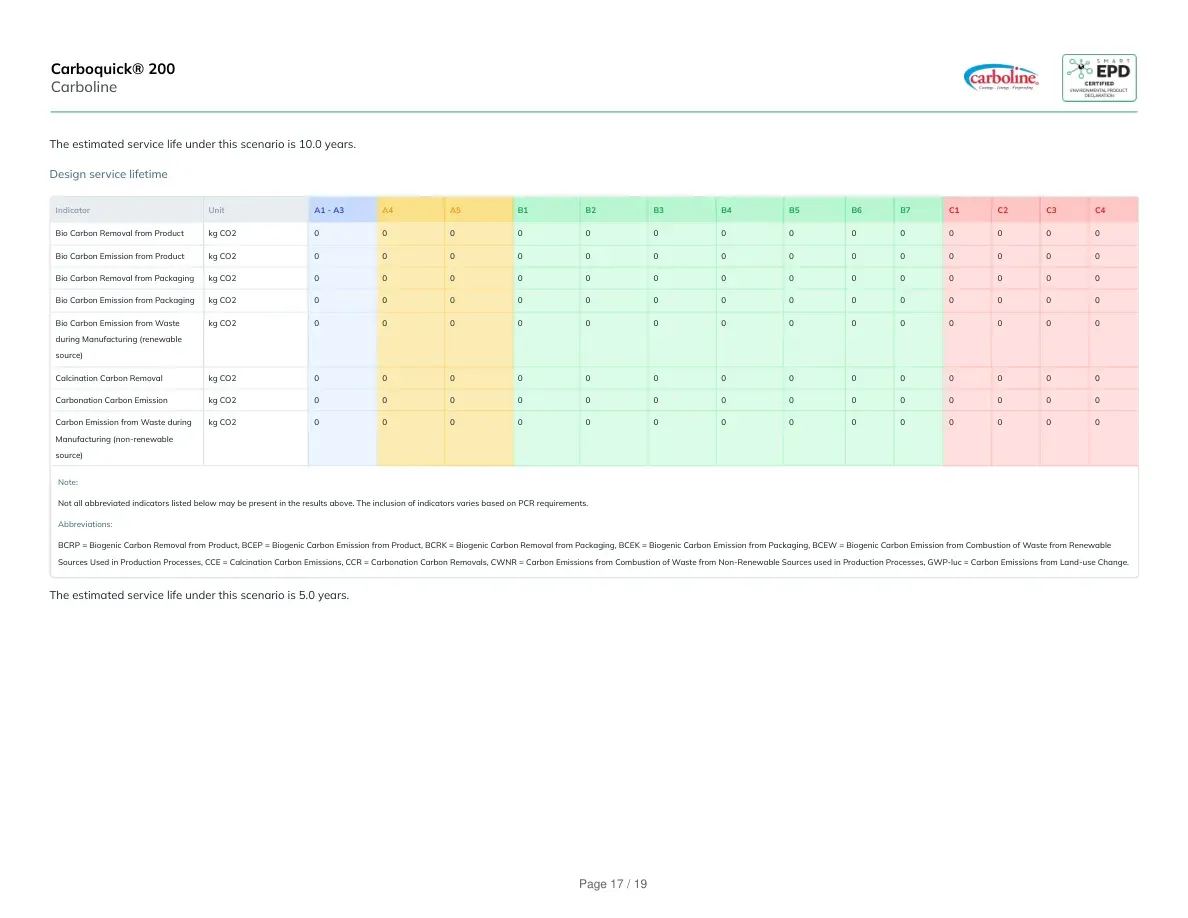
The estimated service life under this scenario is 10.0 years.Design service lifetimeIndicatorUnitA1 - A3A4A5B1B2B3B4B5B6B7C1C2C3C4Bio Carbon Removal from Productkg CO200000000000000Bio Carbon Emission from Productkg CO200000000000000Bio Carbon Removal from Packagingkg CO200000000000000Bio Carbon Emission from Packagingkg CO200000000000000Bio Carbon Emission from Wasteduring Manufacturing (renewablesource)kg CO200000000000000Calcination Carbon Removalkg CO200000000000000Carbonation Carbon Emissionkg CO200000000000000Carbon Emission from Waste duringManufacturing (non-renewablesource)kg CO200000000000000Note:Not all abbreviated indicators listed below may be present in the results above. The inclusion of indicators varies based on PCR requirements.Abbreviations:BCRP = Biogenic Carbon Removal from Product, BCEP = Biogenic Carbon Emission from Product, BCRK = Biogenic Carbon Removal from Packaging, BCEK = Biogenic Carbon Emission from Packaging, BCEW = Biogenic Carbon Emission from Combustion of Waste from RenewableSources Used in Production Processes, CCE = Calcination Carbon Emissions, CCR = Carbonation Carbon Removals, CWNR = Carbon Emissions from Combustion of Waste from Non-Renewable Sources used in Production Processes, GWP-luc = Carbon Emissions from Land-use Change.The estimated service life under this scenario is 5.0 years.Carboquick® 200CarbolinePage 17 / 19
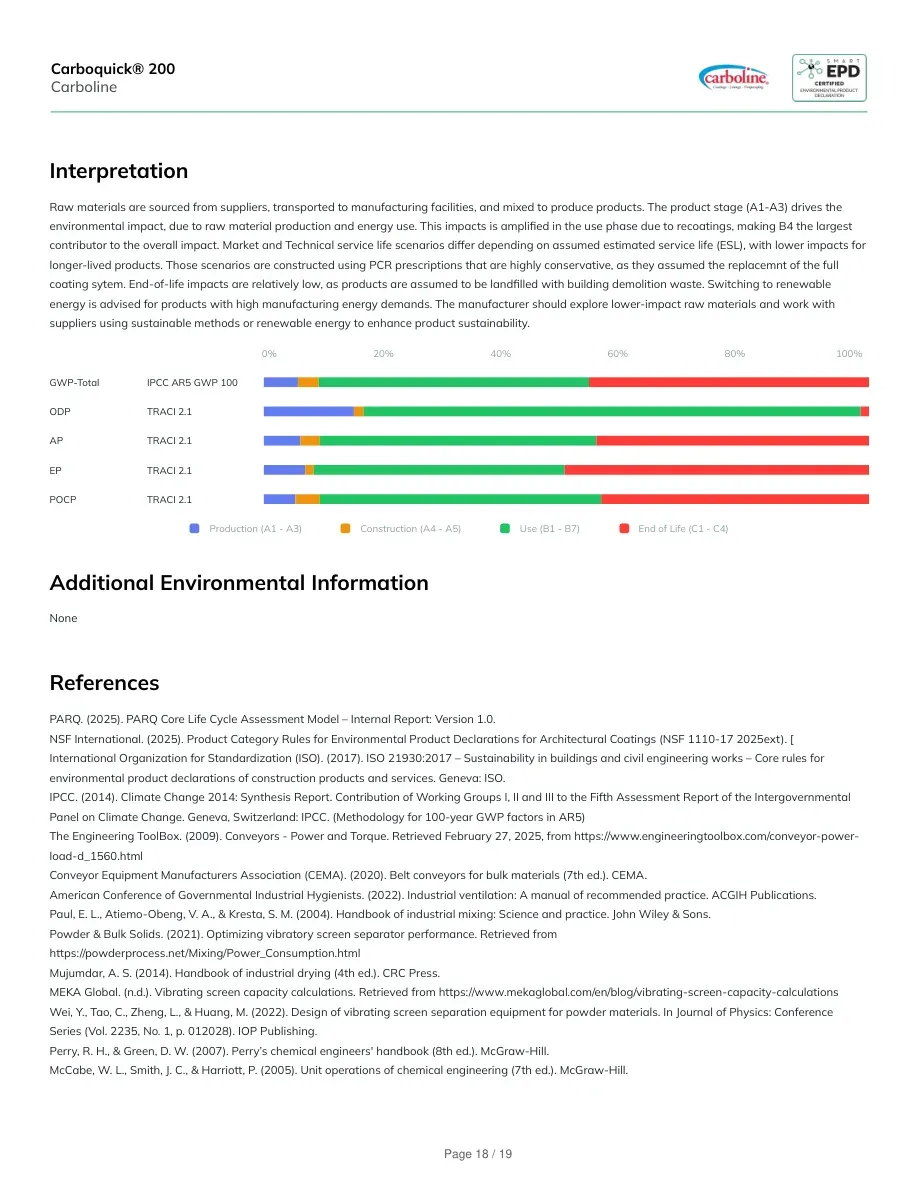
InterpretationRaw materials are sourced from suppliers, transported to manufacturing facilities, and mixed to produce products. The product stage (A1-A3) drives theenvironmental impact, due to raw material production and energy use. This impacts is amplified in the use phase due to recoatings, making B4 the largestcontributor to the overall impact. Market and Technical service life scenarios differ depending on assumed estimated service life (ESL), with lower impacts forlonger-lived products. Those scenarios are constructed using PCR prescriptions that are highly conservative, as they assumed the replacemnt of the fullcoating sytem. End-of-life impacts are relatively low, as products are assumed to be landfilled with building demolition waste. Switching to renewableenergy is advised for products with high manufacturing energy demands. The manufacturer should explore lower-impact raw materials and work withsuppliers using sustainable methods or renewable energy to enhance product sustainability.0%20%40%60%80%100%GWP-TotalIPCC AR5 GWP 100ODPTRACI 2.1APTRACI 2.1EPTRACI 2.1POCPTRACI 2.1Production (A1 - A3)Construction (A4 - A5)Use (B1 - B7)End of Life (C1 - C4)Additional Environmental InformationNoneReferencesPARQ. (2025). PARQ Core Life Cycle Assessment Model – Internal Report: Version 1.0.NSF International. (2025). Product Category Rules for Environmental Product Declarations for Architectural Coatings (NSF 1110-17 2025ext). [International Organization for Standardization (ISO). (2017). ISO 21930:2017 – Sustainability in buildings and civil engineering works – Core rules forenvironmental product declarations of construction products and services. Geneva: ISO.IPCC. (2014). Climate Change 2014: Synthesis Report. Contribution of Working Groups I, II and III to the Fifth Assessment Report of the IntergovernmentalPanel on Climate Change. Geneva, Switzerland: IPCC. (Methodology for 100-year GWP factors in AR5)The Engineering ToolBox. (2009). Conveyors - Power and Torque. Retrieved February 27, 2025, from https://www.engineeringtoolbox.com/conveyor-power-load-d_1560.htmlConveyor Equipment Manufacturers Association (CEMA). (2020). Belt conveyors for bulk materials (7th ed.). CEMA.American Conference of Governmental Industrial Hygienists. (2022). Industrial ventilation: A manual of recommended practice. ACGIH Publications.Paul, E. L., Atiemo-Obeng, V. A., & Kresta, S. M. (2004). Handbook of industrial mixing: Science and practice. John Wiley & Sons.Powder & Bulk Solids. (2021). Optimizing vibratory screen separator performance. Retrieved fromhttps://powderprocess.net/Mixing/Power_Consumption.htmlMujumdar, A. S. (2014). Handbook of industrial drying (4th ed.). CRC Press.MEKA Global. (n.d.). Vibrating screen capacity calculations. Retrieved from https://www.mekaglobal.com/en/blog/vibrating-screen-capacity-calculationsWei, Y., Tao, C., Zheng, L., & Huang, M. (2022). Design of vibrating screen separation equipment for powder materials. In Journal of Physics: ConferenceSeries (Vol. 2235, No. 1, p. 012028). IOP Publishing.Perry, R. H., & Green, D. W. (2007). Perry’s chemical engineers' handbook (8th ed.). McGraw-Hill.McCabe, W. L., Smith, J. C., & Harriott, P. (2005). Unit operations of chemical engineering (7th ed.). McGraw-Hill.Carboquick® 200CarbolinePage 18 / 19

Henry, J. R. (2012). Packaging machinery handbook: The complete guide to automated packaging machinery, including packaging line design. CreateSpaceIndependent Publishing Platform.U.S. Environmental Protection Agency (EPA). (1995). AP-42: Compilation of Air Pollutant Emission Factors – Chapter 5. https://www.epa.gov/air-emissions-factors-and-quantification/ap-42Ullmann's Encyclopedia of Industrial Chemistry. (2012). Epoxy Resins. Wiley-VCH.American Center for Life Cycle Assessment. (2019). ACLCA guidance to calculating non-LCIA inventory metrics in accordance with ISO 21930:2017.https://aclca.org/aclca-iso-21930-guidance/Carboquick® 200CarbolinePage 19 / 19
